3D & Generative prompts from real videos
All 32 3d & generative prompts that creators posted with the videos Claude made from them, most liked first. Each card shows the video, the model the creator named and the full prompt.
The prompts
All 3D & Generative videos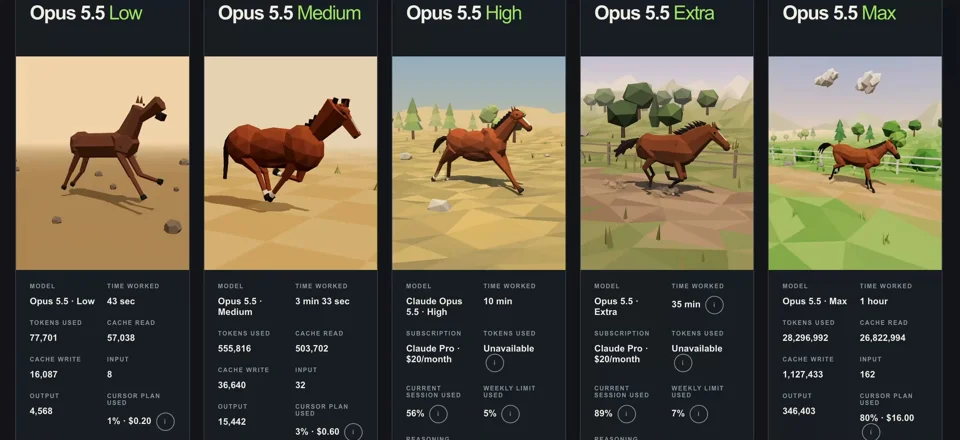 r/ Prompt available0:07
Create a low-poly 3D horse running in a seamless loop using Three.js. Build it procedurally from primitive geometry, animate the legs, body, head, and tail, and return a single self-contained HTML…
Full prompt
Create a low-poly 3D horse running in a seamless loop using Three.js. Build it procedurally from primitive geometry, animate the legs, body, head, and tail, and return a single self-contained HTML file.
 𝕏 Prompt available0:40

one short, soft whoosh per real scene change, and small clicks or pops only on real on-screen actions - screen effects for boom, hiss and length before using them, and set each one just above the…
Full prompt
one short, soft whoosh per real scene change, and small clicks or pops only on real on-screen actions
- screen effects for boom, hiss and length before using them, and set each one just above the music in its own frequency range, with a cap so nothing gets harsh
- cut every scene change on a beat
- always export a music-only version
</audio>

<critic_loop>
the builder never judges its own work.
- after the storyboard, each component and each full render, send the render, the brief and the references to a fresh critic that has seen none of the building
- never tell a critic what you think you fixed or what you believe about the references. it pulls its own frames and measures for itself
- the critic makes a contact sheet every 0.2 seconds plus dense frames around every transition, measures frozen time and loudness, and returns a ranked list of problems with timestamps, ending with ship or one more pass
- fix the biggest problem first, render, then send to a new critic that checks every previous item as fixed, partly fixed or still there, and hunts for anything new that broke
- keep a ledger of every round: what was found, what changed, and the numbers before and after
</critic_loop>

<quality_bar>
the video isn't done until all of these pass, measured:
- no more than about 1 second of frozen screen per 30 seconds, and no still stretch longer than about half a second
- frame one is a finished composition
- all text meets at least 4.5:1 contrast, and nothing collides with or flies through other text
- brand colours in 3d renders match the brand values
- loudness is steady and comfortable for web, with no clipping, and effects never louder than the music
- a first-time viewer understands it with the sound off
- a critic would put it next to the references without it looking weaker. a video with no bugs is not the same as a good video
</quality_bar>

<honesty>
- only put numbers, names and claims on screen that are in the facts file
- no invented testimonials, ratings, prices, savings, warranties or results
- anything conceptual or generated is labelled as such
- in your reports, separate what you measured from what still needs a human to watch or listen
</honesty>

<deliverables>
- the final mp4 in every size requested, at 1080p and 60 frames a second
- a music-only version
- a contact sheet of the final video
- the critic ledger and the final quality bar results
- a short note on anything a human should still check
</deliverables>
 𝕏 Prompt available0:25

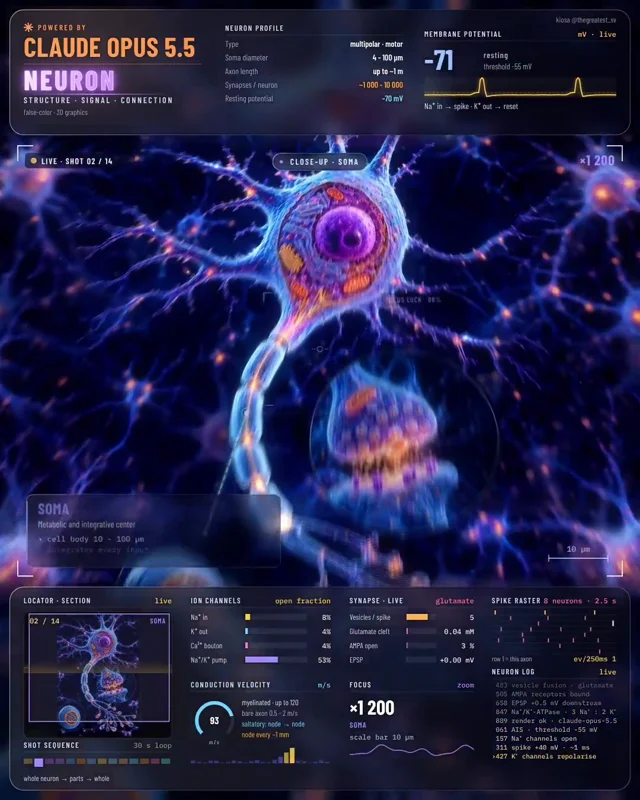
https://t.co/UcgHiqCJQj the neuron in this video? I built it myself with Claude Code and a few 3D and motion tools and sold it for 2K. no studio, no team. want to make something like this? like +…
Full prompt
https://t.co/UcgHiqCJQj

the neuron in this video?
I built it myself with Claude Code and a few 3D and motion tools and sold it for 2K. no studio, no team.

want to make something like this?

like + save this post, comment
 r/ Prompt available0:56
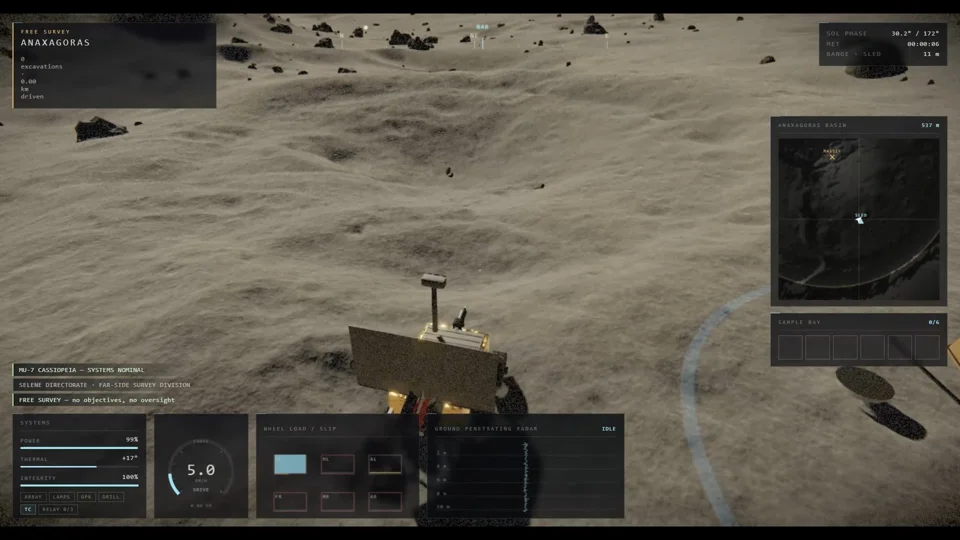
Create me a fully playable release-ready game. On GPU. Game about moon discovery with rover with gravity, moon sand and etc.. I need it in 3D and not a voxel game. Make it with maximum effort, show…
Full prompt
Create me a fully playable release-ready game. On GPU. Game about moon discovery with rover with gravity, moon sand and etc.. I need it in 3D and not a voxel game. Make it with maximum effort, show me best what you can create. Use all your power, knowledge and make best graphics and best game design. Surprise me with graphics, lore and everything.
 r/ Prompt available0:58
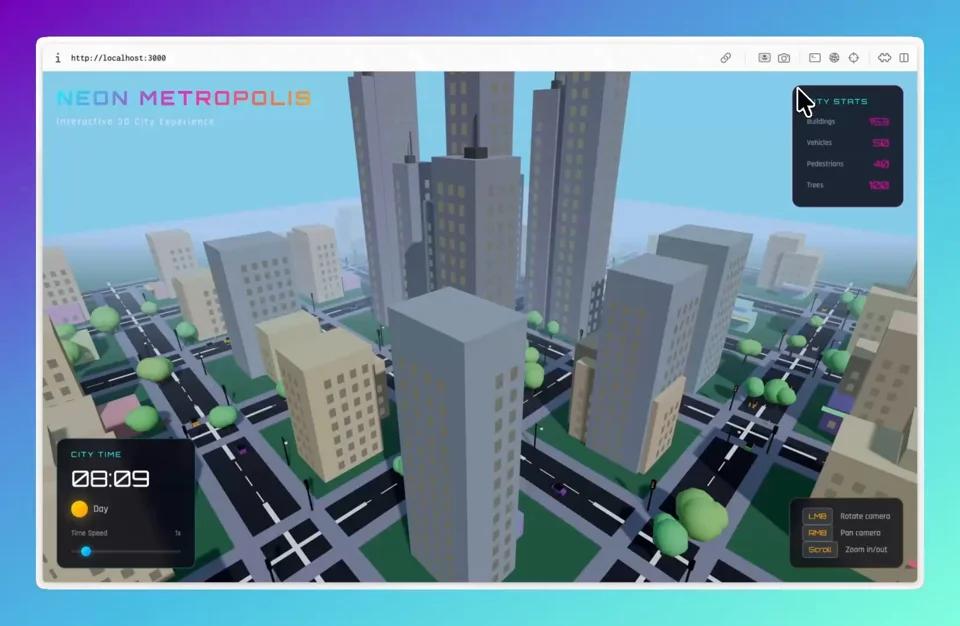
Create a 3D city scene using Three.js that features a bustling urban environment with skyscrapers, apartment buildings, and smaller shops lining the streets. Incorporate roads with moving cars,…
Full prompt
Create a 3D city scene using Three.js that features a bustling urban environment with skyscrapers, apartment buildings, and smaller shops lining the streets. Incorporate roads with moving cars, traffic lights, and pedestrian crossings to bring the city to life. Add pedestrians walking on sidewalks and crossing the streets to enhance realism. Include street elements such as lampposts, benches, and trees for a more immersive experience. Utilize dynamic lighting to simulate day and night cycles, and implement basic camera controls to allow users to explore the vibrant cityscape from different perspectives.
 𝕏 Prompt available0:13

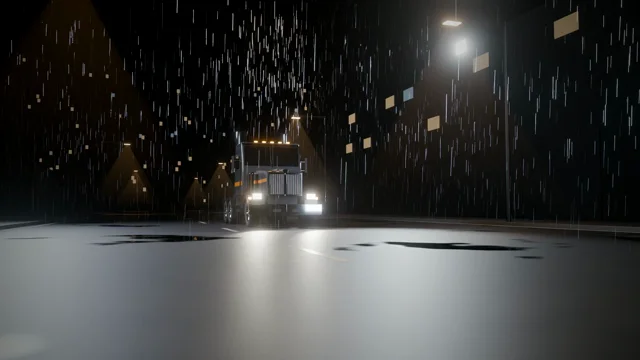
Make me a transformer truck with animations of its transforming. I never touched Blender. 🤯 ⏱️ 107 minutes 💸 $9.64 in API costs 🤖 Claude Fable 5.5 Xhigh in Claude Code What it did on its own 👇…
Full prompt
Make me a transformer truck with animations of its transforming.

 I never touched Blender. 🤯

⏱️ 107 minutes
💸 $9.64 in API costs
🤖 Claude Fable 5.5 Xhigh in Claude Code

What it did on its own 👇

🦾 Rigged 51 joints and baked every one on all 375 frames
🦵 Wrote a ground solver so the feet stay planted while the body rises
🌧️ 5,000 Geometry Nodes raindrops + rippling puddles on wet asphalt
🔊 Synthesized all 64 sound cues from scratch: diesel, air brakes, servos, ratchets, stomps. Zero samples
🔦 Caught its own bugs: headlights aimed backwards, fingers poking through the grille
🔍 Head glowing too hot? It ran 5 test renders to find the culprit (visor bloom + key light)

📦 12.5 s · 1080p30 · 73 robot parts · ~73k tris · Cycles + OptiX · −14.6 LUFS
 𝕏 Prompt available0:20

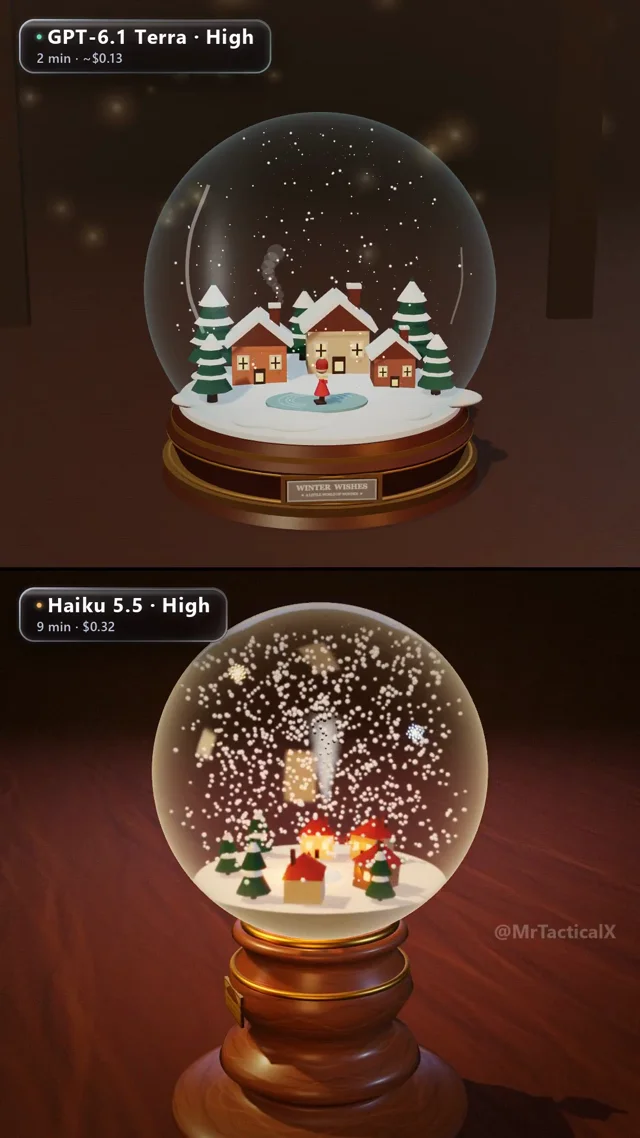
build a 3D snow globe in code (three.js) with a tiny winter village inside, glass, snow and a shake. Top: GPT-6.1 Terra (2 min, ~$0.13) Bottom: Haiku 5.5 (9 min, ~$0.32) Which one did better?
 r/ Prompt available1:00
Create an interactive 3D scene of a matte black cosmetic serum bottle with a gold cap on a soft gradient background. Studio lighting with a key light upper left and a subtle rim light. Slow…
Full prompt
Create an interactive 3D scene of a matte black cosmetic serum bottle with a gold cap on a soft gradient background. Studio lighting with a key light upper left and a subtle rim light. Slow auto-rotation. Floating shadow beneath. Minimal, luxurious, Apple-style presentation.
 𝕏 Prompt available0:24

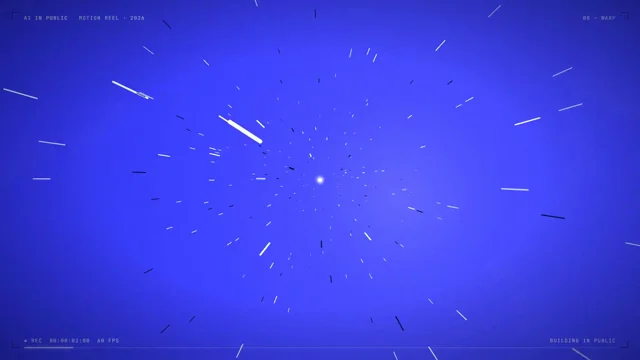
A 24-second AI In Public motion reel in Remotion at 1920×1080, 60fps. Use our blue # 3D40FE, white, navy, and ice palette with the AI In Public logo and sparkle. Keep it fast, premium, and smooth…
Full prompt
A 24-second AI In Public motion reel in Remotion at 1920×1080, 60fps. Use our blue # 3D40FE, white, navy, and ice palette with the AI In Public logo and sparkle. Keep it fast, premium, and smooth with motion blur, glow, camera hits, HUD details, seamless transitions, kinetic type, terminal UI, neural visuals, particles, and a cinematic logo finale. Generate all suspenseful music and sound effects in code and sync every hit perfectly. End with “AI IN PUBLIC, learning AI, out loud.
 𝕏 Prompt available1:19

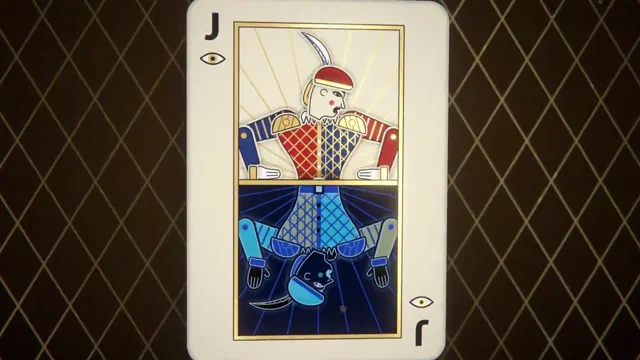
make a creative music video with dancing or a story, entirely in motion graphics. No shot list or technical instructions. It built this using only Three.js and Canvas 2D.
 𝕏 Prompt available0:20

Add Remotion's Three.js package and the React Three postprocessing library to my Remotion project. Rebuild the hero scene in real 3D: my app screens as floating panels around a phone, a slow camera…
Full prompt
Add Remotion's Three.js package and the React Three postprocessing library to my Remotion project. Rebuild the hero scene in real 3D: my app screens as floating panels around a phone, a slow camera orbit, a soft key light and a violet rim light. Add bloom on the bright parts, light chromatic aberration and film grain. Use Remotion's seeded random() so every frame renders the same. Keep all timings in one config file."

two things that save you an hour:

→ render with gl set to "angle". the Remotion docs say Three.js doesn't work with the default OpenGL renderer
→ 3D renders slower. preview at --scale=0.5 before the full render

everything in this video is rendered from code. no Blender, no After Effects.

full workflow in the article ↓
 𝕏 Prompt available1:05

Recreate this video as a hand-drawn colored pencil + watercolor animation. Rules: - Vanilla JavaScript + HTML canvas only. Draw every frame yourself in code. Never trace or filter the source frames.…
Full prompt
Recreate this video as a hand-drawn colored pencil + watercolor animation.

Rules:
- Vanilla JavaScript + HTML canvas only. Draw every frame yourself in code. Never trace or filter the source frames. Use them only as reference for shots, poses, timing and camera moves.
- Match the source's cuts. Go through it shot by shot and write a shot list with timestamps.
- Draw 12 new frames per second, each with slightly different line jitter so it looks like frame-by-frame animation.
- Style: colored pencil outlines in 2 passes with varying pressure, pencil hatching for shadows, watercolor washes under the lines, paper grain texture. Distinct color per character.
- Build reusable, posable characters and props, and drive all motion from keyframes. Close-ups are camera zooms into the same drawings.
- Transcribe the voice-over with word timestamps. Hand-letter every word on screen at the moment it is spoken, as part of the design: highlight, underline or box the key words.
- Render test stills of every scene, look at them, fix what looks wrong, then render all frames and mux with the original audio in ffmpeg.
- Check the first and last frames. No black frames.

Took one session.

The whole film is JavaScript.

Astra 6 is old news...
 r/ Prompt available0:41
Clone [https://github.com/elliottdehn/wam](https://github.com/elliottdehn/wam) and make me a model that I can see... It will generate a prompt for you using a script if you do not provide a brief,…
Full prompt
>Clone [https://github.com/elliottdehn/wam](https://github.com/elliottdehn/wam) and make me a model that I can see...

It will generate a prompt for you using a script if you do not provide a brief, basically rolling the dice.

**You get a rigged, animated, textured low-poly model, a glTF you can drop into your engine, and (optionally)** ***a link you can share.*** One-shots are decent, but iteration is where the power is at.

Paste it into Claude, ChatGPT Work ("Chat" for ChatGPT does not work), or any agentic LLM. I heard in the previous thread that Claude Web may complain about the prompt. That's normal for anything involving git clone. If you'd rather not, ask it to audit the repo first.

The update: now when the model is done, you can share it with others via [WAMShare](https://wamshare.com). There are two options: unlisted (all rights reserved) and public (CC0 1.0). **This is 100% optional and requires your explicit approval to go through the workflow at all.** Claude cannot upload to WAMShare from the mobile or web apps. ChatGPT can.

# Try it without installing anything

[**https://wamshare.com/gallery**](https://wamshare.com/gallery)

Models people have put up (all CC0, source downloadable on each page):

* [Happy Hound](https://wamshare.com/m/a896ecde2f2016af00e4a040de8a3f02): 237 lines of sourcce
* [Carcinized Tank](https://wamshare.com/m/982b36fe924030166dd8a0fb35113ad4): 1,588 tris, 29 bones, walk + target-acquired
* [Printer Mimic](https://wamshare.com/m/9b952ecf2e85543d04e77c5930d4a26e): 1,268 tris, 26 bones
* [The $1.50 Seraph](https://wamshare.com/m/15b83982f8916583cda1fc738ca284b1): 1,596 tris, flight animation

Each page gives you the model spinning, the highlighted source, and a download button for both the `.wam` and the glTF.

# What's new since last time

* WAMShare. The ability to share viewable WAM files is the big update.
* Tons of bugfixes and feature additions, as I've been using WAM myself.
* (Unchanged) Still 100% free to use, have no plans to monetize this.

# The bit that makes it not garbage

The LLM never touches a vertex. It writes a text file of **discrete, named decisions**: bone angles, ring widths, palette colours, relationships between parts. A compiler generates every vertex, weight, normal and winding.

    palette
      voidstone  #171928 metal=0.72 rough=0.30
      starfire   #55e6ff rough=0.16

    skeleton
      bone neck parent=body2 dir=fwd pitch=-5 len=0.16 bend=pitch,yaw
      bone head parent=neck  dir=fwd pitch=2  len=0.23 bend=pitch,yaw

That's the whole trick. Asking a model to emit triangle soup gives you triangle soup. Asking it to make the decisions an artist actually makes, and having a compiler do the geometry, gives you something manifold and riggable, because producing a broken mesh isn't in the grammar.

# Models check themselves

Every model carries its own assertions, re-run on every compile:

    assert zmax(upper_maw) > zmax(neckplate)      # the jaw clears the collar
    assert moves(lower_maw, money_shot) > 0.12    # the attack actually moves
    assert slide(foot.l, walk) < 0.02             # the walk isn't moonwalking
    assert tris < 6500

That last-but-one is a real detector: it sums forward motion of a foot while it's on the ground. A correct gait reads 0. It caught a gait of mine that looked completely fine in a render.

This is the thing that makes agent-authored 3D actually converge. The agent writes down what it believes, and the compiler tells it when that stops being true three edits later.

# Limits

* **It's stylised low-poly.** Think RuneScape/WoW silhouettes, 1k to 3k triangles. Not photoreal, not high-poly, not for a hero character in a AAA pipeline.
* **It takes iteration.** The good ones aren't one-shot. A three-headed dragon I made needed the wings restructured, the head layout rebuilt twice, and four rounds on the walk cycle before it read properly at thumbnail size.
* **Silhouette is the hard part, not detail.** The single most common failure is a model that accumulates spikes and studs and still reads as a generic humanoid. The repo ships a doc about this because it cost me hours.
* **No hand-painted texturing.** Procedural operators only: gradients, noise, bands, planks, AO.

# Links

* Repo: [https://github.com/elliottdehn/wam](https://github.com/elliottdehn/wam)
* Try it: [https://wamshare.com](https://wamshare.com)

MIT, no signup, nothing to buy. Happy to answer questions about the language design. The interesting constraint was making it so the author only ever makes discrete relative choices and never writes a coordinate. r/ Prompt available0:32
launch subagents on sonnet 5.5 and help me build a triple A quality game that is a realistic NYC wildlife simulator where you can be either a rat, pigeon, or squirrel. Build it with…
Full prompt
launch subagents on sonnet 5.5 and help me build a triple A quality game that is a realistic NYC wildlife simulator where you can be either a rat, pigeon, or squirrel. Build it with React/Typescript/three.js. Build the game without asking me any questions. Make me proud.
 r/ Prompt available0:46
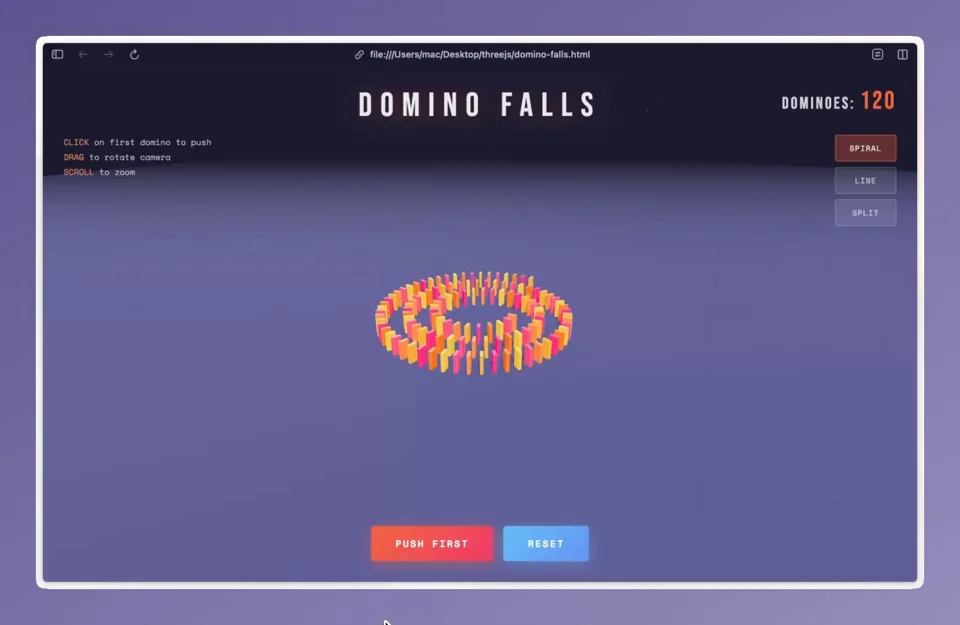
Create an interactive 3D domino effect simulation using Three.js and Rapier.js with realistic physics and sounds.[](https://x.com/ozgrozer/status/1994074599433076867)
 𝕏 Prompt available0:30

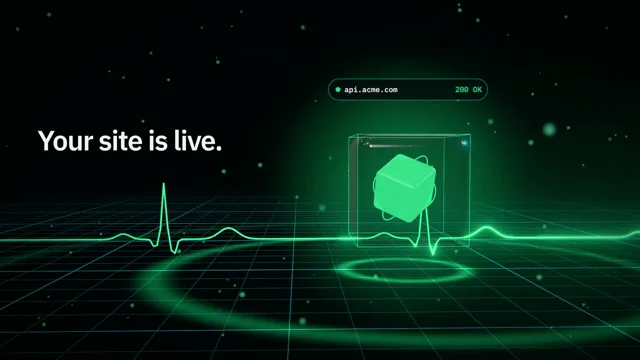
make a dynamic 30-second motion graphics video about Uptimepage. not too fast, people should actually understand what it's about. use three.js
 𝕏 Prompt available0:20
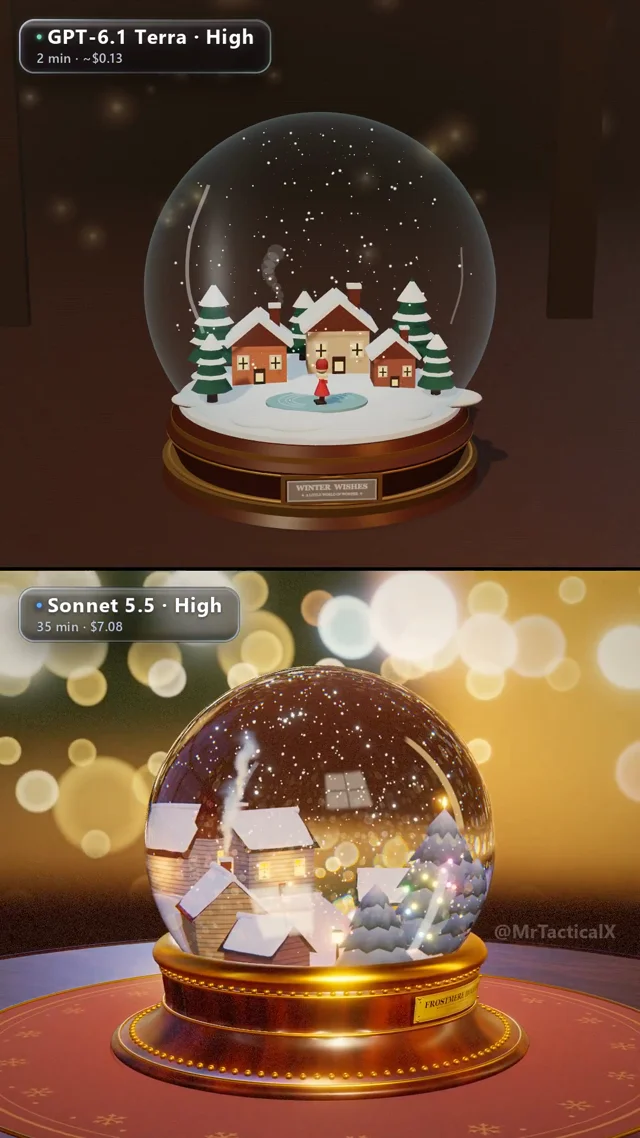
build a 3D snow globe in code (three.js) with a tiny winter village inside, glass, snow and a shake. Top: GPT-6.1 Terra (2 min, ~$0.13) Bottom: Sonnet 5.5 (35 min, $7.08)
 𝕏 Prompt available0:43

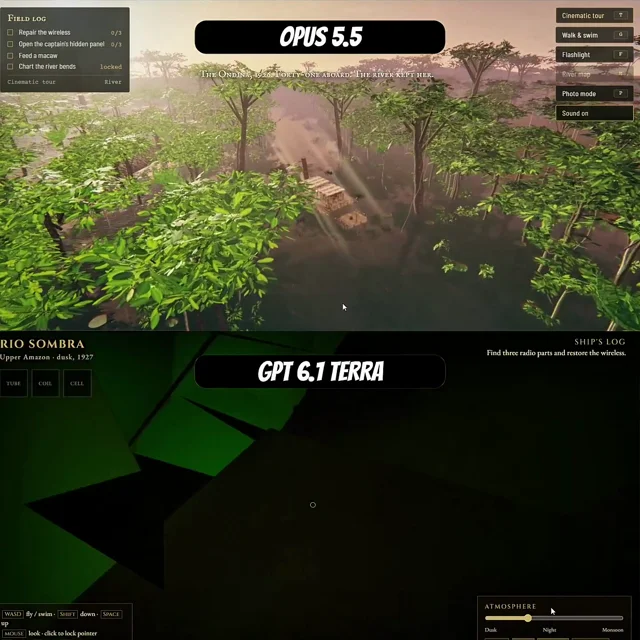
a full interactive Three.js scene of a derelict 1920s river steamer half-sunk in a flooded Amazon jungle at dusk > GPT 6.1 Terra finished in 38 min > Opus 5.5 finished in 55 min imo, Terra was…
Full prompt
a full interactive Three.js scene of a derelict 1920s river steamer half-sunk in a flooded Amazon jungle at dusk

> GPT 6.1 Terra finished in 38 min
> Opus 5.5 finished in 55 min

imo, Terra was faster, and for a model that already feels a generation behind that's still a big w for OpenAI

but Opus is still unbeatable lol, slower clock, better scene, denser atmosphere, tighter interactivity

watch both and tell me which one you liked the most
 𝕏 Prompt available0:12

Prompts listos para webs 3D, portfolios, dashboards y landings. Hay desde una web de jets privados con animación atada al scroll hasta estudios creativos con tarjetas 3D. 4. React Bits - Componentes…
Full prompt
Prompts listos para webs 3D, portfolios, dashboards y landings.
Hay desde una web de jets privados con animación atada al scroll hasta estudios creativos con tarjetas 3D.

4. React Bits -
Componentes React animados: textos, fondos, cursores y tarjetas.
Gratis y open source. Se instalan con CLI, perfecto para que tu agente los añada.

5. Codrops -
Cientos de demos con tutorial y repo en GitHub.
Pásale una demo a tu agente y pídele que la adapte a tu proyecto.

6. Unicorn Studio -
Más de 60 efectos WebGL sin escribir código.
Lo diseñas como en Figma y lo incrustas en Framer, Webflow o cualquier web.

7. Spline -
Diseña, anima y publica escenas 3D desde el navegador.
Editor de arrastrar y soltar. Lo embebes y tu agente lo conecta al scroll.

8. GSAP -
El estándar para animaciones con scroll y timelines.
Ahora es gratis completa, con ScrollTrigger incluido. Cualquier agente sabe usarla.

9. Lenis -
Scroll suave con inercia en 3KB.
Es lo que hace que una web se sienta cara.

10. Mobbin -
Interfaces reales de apps y webs para sacar referencias.
Enséñale capturas a tu agente en vez de describirle lo que quieres con palabras.

No tienes excusa si tu agente monta la misma web morada de siempre brother

Guarda esto.
 𝕏 Prompt available0:16

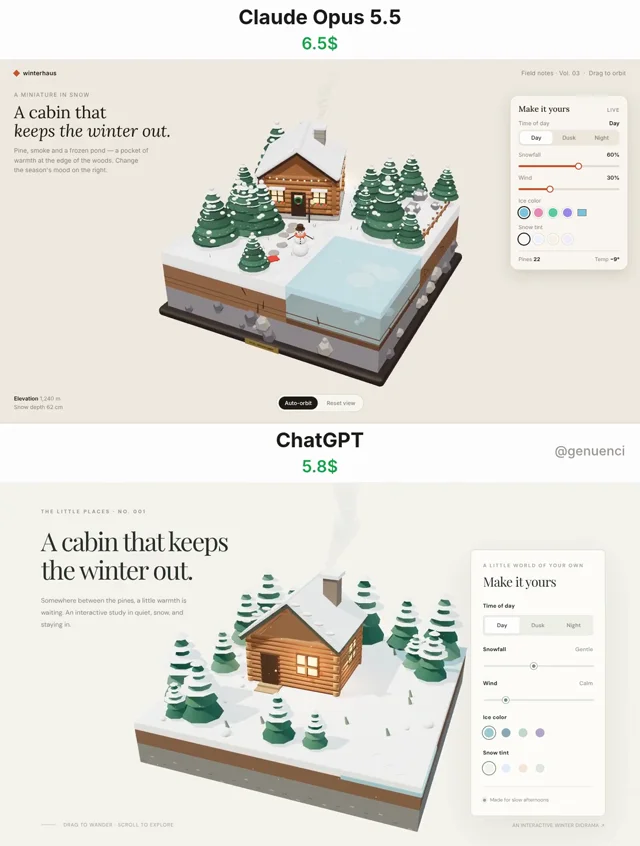
icicles, string lights, a wreath on the door, a sled, footprints to the pond, and an aurora at night. •ChatGPT's typography and panel are genuinely nice. Clean, calm, very "design studio". •At night…
Full prompt
icicles, string lights, a wreath on the door, a sled, footprints to the pond, and an aurora at night.

•ChatGPT's typography and panel are genuinely nice. Clean, calm, very "design studio".

•At night is where it splits. Claude flips the whole page to dark with stars and an aurora. ChatGPT just dims the scene.

70 cents more for a page that actually loads and has an aurora.

Which one would you ship? 👇
 𝕏 Prompt available0:18

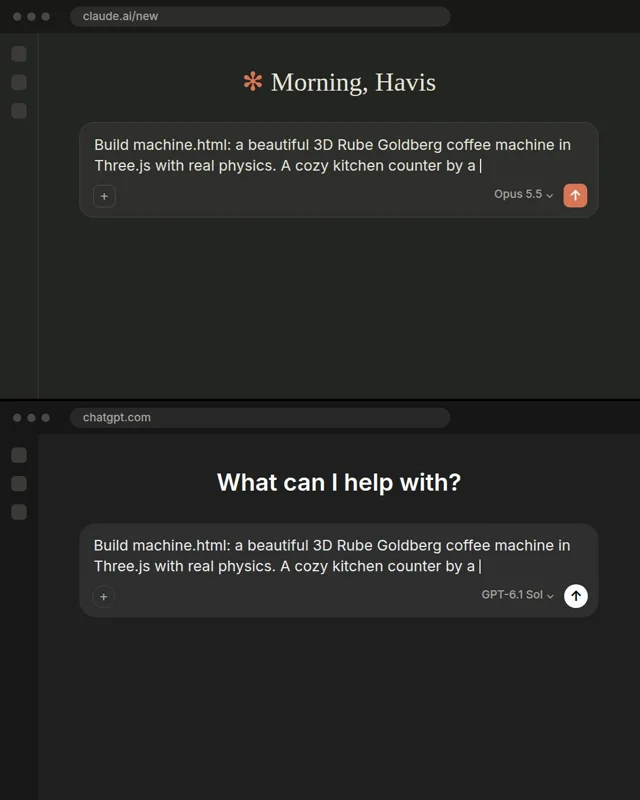
a 3D Rube Goldberg coffee machine in Three.js with real physics. Morning sunbeams, a steel marble, 8 dominoes, a lever, a bucket, a pulley, a coffee pot and a flag that says COFFEE READY. One try…
Full prompt
a 3D Rube Goldberg coffee machine in Three.js with real physics. Morning sunbeams, a steel marble, 8 dominoes, a lever, a bucket, a pulley, a coffee pot and a flag that says COFFEE READY. One try each.

/ Claude Opus 5.5: 32 min, ~$5.11. Shot it like a movie, the camera chases every domino.
/ ChatGPT: 28 min, ~$1.55. One cozy diorama by the window, you see the whole machine at once.

Claude cost 3x more. Worth it?

Top: Claude. Bottom: ChatGPT.
 𝕏 Prompt available0:06

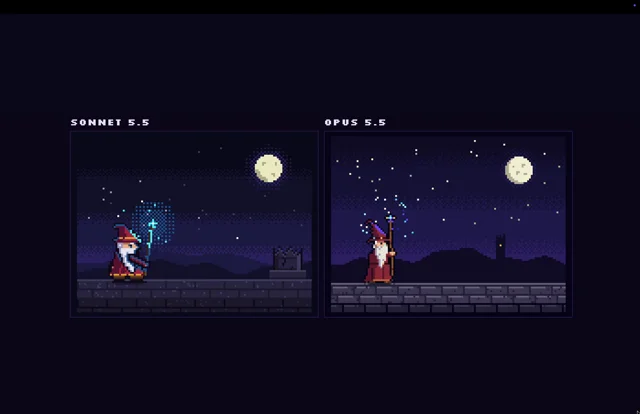
animated pixel art wizard, canvas 2d, 128x96, fixed palette, particle pool, no libraries. sonnet 5.5 → ~12.8 min, 105k output tokens, ~$1.71 est. opus 5.5 → ~11.4 min, 68k output tokens, ~$2.17 est.…
Full prompt
animated pixel art wizard, canvas 2d, 128x96, fixed palette, particle pool, no libraries.

sonnet 5.5 → ~12.8 min, 105k output tokens, ~$1.71 est.
opus 5.5 → ~11.4 min, 68k output tokens, ~$2.17 est.

prompt below.
 r/ Prompt available1:43
Research the code-based motion-graphics tools available today (like p5.js and three.js), then use several of them to make a set of versatile 10-second motion-graphics demos on the theme of Linkin…
Full prompt
Research the code-based motion-graphics tools available today (like p5.js and three.js), then use several of them to make a set of versatile 10-second motion-graphics demos on the theme of Linkin Park, interpreted however you like."

The video has 10x10s clips where different technologies are in use. This is not video from a AI video model, it is mostly Opus writing code which runs on a browser and then is captured frame by frame, and one case of it using Blender.

Used Claude Code with Opus 5.5 with maximum effort (with dynamic workflows), took around 16 hours as it worked through everything.

Music:

Made locally on a RTX 3080 with ComfyUI and Step Ace 1.5, driven by Opus 5.5

Iteration:

The videos are all 1-shot, originally Opus made a sample 10s audio clip and used it on all the clips, I later asked it to make a single coherent song throughout using the available local AI model for music generation.
 𝕏 Prompt available0:45

Create a beautiful Sonic-inspired endless runner using Three.js and WebGL, with smooth controls, polished visuals and refined interactions. Deliver it as HTML.” The gameplay is so smooth. Play it…
Full prompt
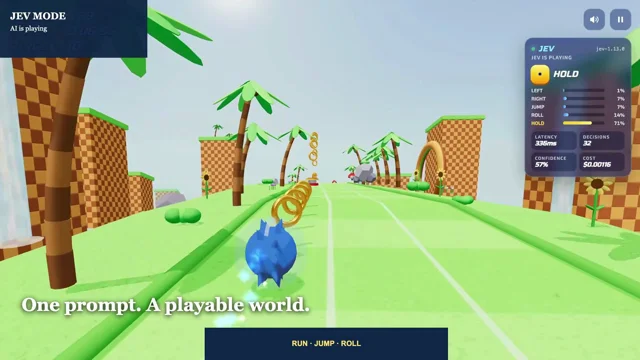
Create a beautiful Sonic-inspired endless runner using Three.js and WebGL, with smooth controls, polished visuals and refined interactions. Deliver it as HTML.”

The gameplay is so smooth. Play it yourself, or let Jev decide when to jump, roll and dodge.

10+ minutes in. Still running. Still watching.
Try it Now with YouWare 👇🏻
 𝕏 Prompt available1:26

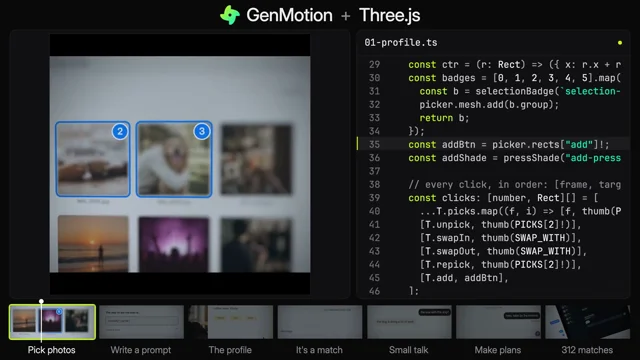
The way to win me over is…". Typed "honestly? just be kind", deleted word by word, retyped (1.08× slower) as "honestly? just be kind." The caret is purple #5b2a86 and blinks on a 9-frame cycle when…
Full prompt
The way to win me over is…".
      Typed "honestly? just be kind", deleted word by word, retyped (1.08× slower) as
      "honestly? just be kind." The caret is purple #5b2a86 and blinks on a 9-frame cycle
      when idle. "Edited 8 times" flips to "Edited 9 times" with a small pop. The I-beam
      waits by the field, then the arrow travels to Done and clicks. Slow push from 1.0 to
      1.08 over 150 frames.</beat>
  </scene>

  <scene id="02" file="scenes/02-swipe.ts" name="The swiping" frames="487" act="I">
    <beat>Hinge-style feed: the cursor clicks the heart on a prompt (heart pops 0.3→1.25→1).</beat>
    <beat>Opener 1: a chat with Ava, "hey :)" typed fast (pace 0.62, typed without looking)
      and sent. The bubble rises 30 px and scales 0.6→1.04→1.</beat>
    <beat>Bumble-style yellow card: the check button is clicked. Opener 2 (Mia).</beat>
    <beat>Tinder-style deck: a card is grabbed, dragged 260 px, released and flicked with
      motion smear. Opener 3 (Lena). A second, faster flick. Opener 4 (Zoe).</beat>
    <beat>The blur: 27 different people, one card per cut. Cut lengths
      10, 9, 8, 8, 7, 7, 6, 6, 5, 5, 5, 4, 4, 4, 4, 3, 3, 3, 3, 3, 3, 2, 2, 2, 2, 2, 2 frames.
      Each card holds for half its cut, then is flicked (88% right, 12% left so it reads as
      a choice); the next card is already underneath.</beat>
    <beat>The counter "MATCHES n" in the bottom letterbox bar: muted eyebrow 28 px, tracking
      0.16; ink value 40 px. It counts 1–4 with the four matches, then rises geometrically to
      312 (c = 4·(312/4)^((i+1)/27)) and pops 1.06× on every change.</beat>
    <beat>The match list: every row reads "You: hey :)", "Delivered". About 48 frames in,
      Jordan's row slides in from the left over 10 frames. The camera eases to it and the
      counter fades out. Everything dims out over the last 8 frames.</beat>
  </scene>

  <scene id="03" file="scenes/03-the-one.ts" name="The one" frames="372" act="II">
    <beat>The film slows down. One Hinge thread, built as the camera travels down it, keyed
      between items. Messages land as an exchange: Sam first, Jordan 12–18 frames later.</beat>
    <thread>
      Tuesday 9:14 PM · them: "ok your third photo is unfair." · me: "the one with the dog?" ·
      them: "the dog is doing a lot of work" · me: "he's my agent. he takes 15%" ·
      11:40 PM · them: "ok but the pigeon thing" · me: "the pigeon is real. he waits for me" ·
      them: "pigeon update tomorrow or i riot" · voice note 0:38 (played twice) ·
      1:07 AM · me: "i listened to that twice" · them: "the pigeon deserved it" ·
      me: "drinks thursday?" · them: "yes!!"
    </thread>
  </scene>

  <scene id="04" file="scenes/04-thursday.ts" name="Thursday" frames="750" act="II">
    <beat frames="18">Sam sends: "here, table by the window." under "Thursday 7:52 PM".</beat>
    <beat frames="120, 210">Hard cuts to the clock: 8:10, then 8:25. Each holds longer than
      is comfortable. The clock rides the letterbox HUD.</beat>
    <beat frames="318–470">The typing indicator appears (318). The camera leans in
      (322–378) until the dots fill the frame. They go (392), come back (410), go (432).
      Pull back to the reply box (436–470).</beat>
    <beat frames="478–~650">The cursor clicks into the reply box. "no worries if" is typed
      hesitantly (pace 1.12) and word-deleted. "everything ok?" is typed (1.1) and
      word-deleted. The caret sits there, blinking.</beat>
    <beat frames="~650–750">The dots return, locked dead centre at lockZoom, flat, on the
      beat. Handoff: they sit at the world origin at exactly the size Act III opens with.</beat>
  </scene>

  <scene id="05" file="scenes/05-repetition.ts" name="The repetition" frames="375" act="III">
    <beat>The dots never move again. One indicator stays at the world origin while the
      conversation behind it changes on every pulse. 24 cuts, one per pulse, speeding up:
      21, 21, 20, 19, 18, 17, 16, 14, 13, 12, 11, 10, 9, 8, 7, 6, 6, 5, 5, 4, 4, 3, 3, 3 frames.
      Every page is anchored so its own dots land on the origin.</beat>
    <chats note="each caught at its most promising moment, then the dots">
      Riley (iMessage) "wait we should actually do this" · Noor (WhatsApp) "saturday works" ·
      theo.k (Instagram) "you're kind of great" · Maya (iMessage dark) "ok that's actually so
      funny" · Eli (Bumble) "i know a place. you'd love it" · Priya (Tinder) "is it weird i
      already like you" · Dev (WhatsApp dark) "tell me everything tomorrow" ·
      Sasha (Hinge) "same time next week?"
    </chats>
    <beat>The pull-back, 110 frames. The camera stops cutting and pulls back on a log-space
      zoom from lockZoom to 0.03, rolling −0.9 rad, while the rig tilts (0.32, −0.12). The
      one chat turns out to be a single tile in a 15×15 wall of identical typing chats,
      spaced 1580×1360 page px, with z jitter of ±1.2. Tiles share the source pages' geometry
      and material, so the wall is cheap.</beat>
    <beat>The twist, frames E+36 to E+48 (E = end of the cuts): the live tile's left
      neighbour is "Robin" in iMessage ("so… are we still on?"), with Sam's dots on the right
      in blue. Readable for about 12 frames.</beat>
    <beat>Black over 10 frames, then silence.</beat>
  </scene>

  <scene id="06" file="scenes/06-loop.ts" name="The loop" frames="139" act="coda">
    <beat frames="0–16">Black. Nothing.</beat>
    <beat frames="18–52">An iPhone lock screen (860×1240, corner radius 120; "Thursday,
      October 16", "11:48") lights up. A Tinder notification with the real flame drops in:
      "It's a match!". A fingertip tap ring at 52.</beat>
    <beat frames="56–~125">An empty chat. The cursor clicks the box (70) and types "hey"
      (pace 1.15). It hovers a breath too long over send (about 22 frames), then sends. The
      counter reads 313. Cut 6 frames later.</beat>
  </scene>
</scenes>

<sound name="scripts/score.py — synthesised locally, locked to timeline.ts">
  - Python + numpy/scipy at 48 kHz. The script reads timeline.ts through node, so
    re-running it after a retime re-syncs everything.
  - Output: assets/score-music.wav (the bed, track 0) plus one WAV per effect in
    assets/sfx/<nn>-<name>.wav, each its own timeline clip on tracks 1–3, packed so no two
    overlap. The script rewrites project.json's audio list (72 clips).
  - Each clip starts exactly on a frame boundary. When a sound's sync point isn't its first
    sample (a reverse swell into a hit), the file is padded so the sync point still lands on
    its frame. One linked limiter levels the mix to −14 LUFS with true peak under −1 dBTP,
    so every clip plays at volume 1.
  - Bed: drones, risers, a "sent" chime, a wake bell, a drag tone, a dark swell, a tinnitus
    tone, and the dots' lub-dub pulse as the score.
  - Effects: picker clicks, keystrokes and Option-Backspace taken from the typing model's key
    times (Tactile keys, Soft clicks), swipe whooshes, send swoops, message pops (different
    for me and them), a muffled voice note played twice, single clock ticks at 8:10 and
    8:25, the Thursday dots pulse (429 frames), heartbeat cuts (305 frames), the wall-reveal
    hit, a thud on the cut to black, the match notification, the tap, and one last send.
  - Silence is a beat: hold true silence for the black between the two halves.
</sound>

<file_structure>
  components/core.ts      stage (PX, FOV 30, fitCamera), framing(), easings (outCubic,
                          inOutCubic, inOutSine, inOutQuint, outExpo), prog(), keyed(),
                          rng(), hash(), withFonts()
  components/film.ts      grain + vignette/letterbox/fade/flash layers, hud group, hudLabel()
  components/hud.ts       letterbox counter/clock: eyebrow + value with pop and rise
  components/page.ts      Kit painter, makePage() with the lens shader, placeOn(), mixRect(),
                          cursor, mousePath(), pressShade()
  components/apps.ts      photoPicker, profileEditor, hingeFeed, bumbleCard, tinderDeck,
                          tinderTop, chatPage, threadPage, matchList, newRow, jordanThursday,
                          convoPage, twistPage, iphoneLock, iosNotification, STYLES, CONVOS
  components/chat.ts      typer, bubble, smallText, typingIndicator, selectionBadge,
                          heartMesh, lockZoom, GRADE
  components/photos.ts    fictional photo set + withPhotos(): Sam ×10 (no faces), matches
                          ×4, swipe cards ×27
  components/timeline.ts  every event: typing model, PROFILE, SWIPE, ONE, THU, REPEAT,
                          LOOP, SCENES
  scenes/01–06            one act each
  scripts/score.py        the score and every sound effect
</file_structure>

<quality_bar>
  - Capture frames at every beat. The one thing that matters must be the only sharp,
    bright thing in the frame; nothing else may compete.
  - Typed text matches the keystroke sounds to the frame.
  - The dots are exactly the same size, grey and position across the Act II→III cut and
    across all 24 cuts.
  - The blue tile is legible for about 12 frames during the pull-back.
  - Nothing is ever fully still: handheld drift, lens breath and grain run on every frame.
  - The final cut lands on "313".
</quality_bar>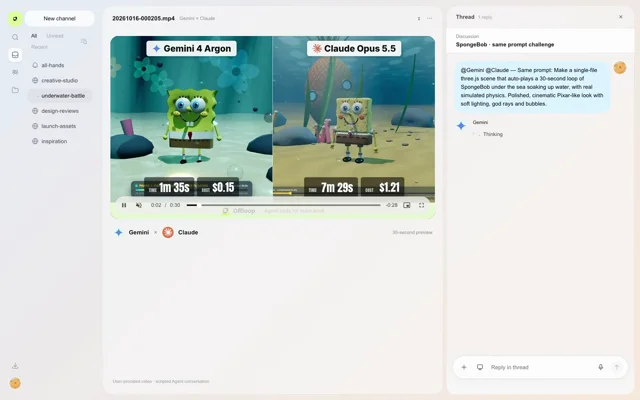 𝕏 Prompt available0:30

build a 30-second Three.js scene of SpongeBob soaking up water. put both versions in the video player, then scripted the agents reviewing each other in the thread beside it. ->Claude questions the…
Full prompt
build a 30-second Three.js scene of SpongeBob soaking up water. put both versions in the video player, then scripted the agents reviewing each other in the thread beside it.

->Claude questions the physics.
-> Gemini questions the lighting.

and then i'm just sitting there typing “now review each other’s final version” like an art director whose entire production team is arguing about a sponge.
 𝕏 Prompt available0:14
workbench/ with every element's rounds, scores and final verdict - the 60fps film at full resolution, plus the side-by-side player if asked for - a short note: what beats the reference, what's still…
Full prompt
workbench/ with every element's rounds, scores and final verdict
- the 60fps film at full resolution, plus the side-by-side player if asked for
- a short note: what beats the reference, what's still below it and which builder should fix it, and the total spend
</deliverables>
 𝕏 Prompt available0:16

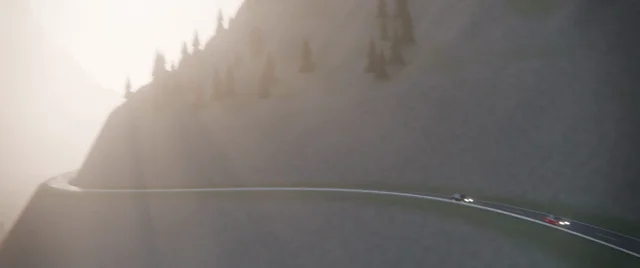
in blender make a previs of a car driving thru a mountainside with a another car chasing. record a video and show me here when its done.
 𝕏 Prompt available0:40

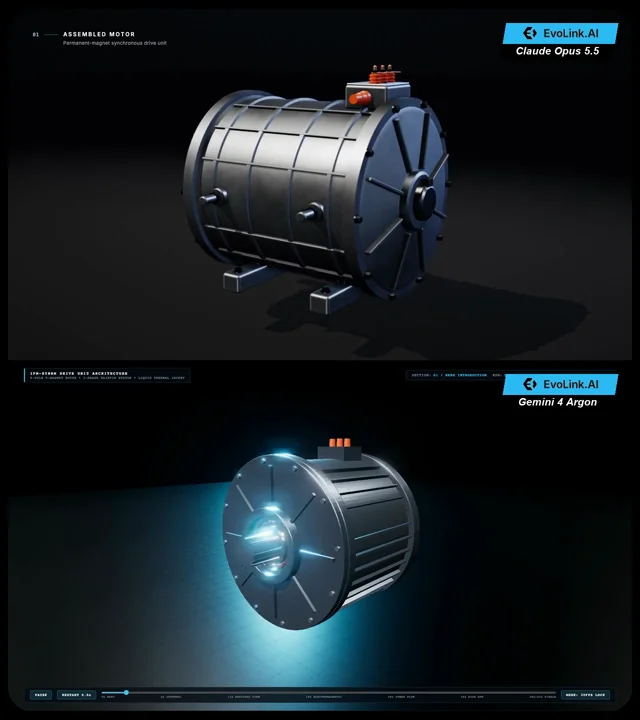
create a 40-second Three.js animation explaining how an electric motor works. Which one would you use to teach a beginner, and why? Prompt in the replies 👇
 𝕏 Prompt available0:04

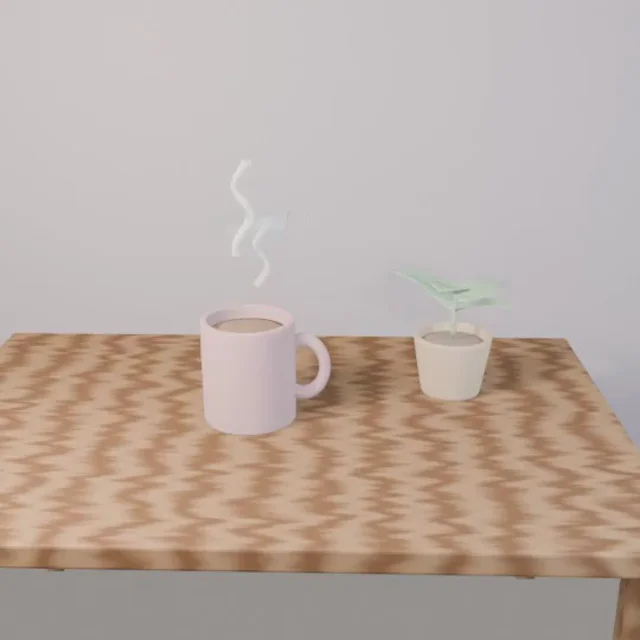
build a looping claymation desk scene in Blender. Mug with rising steam, potted plant, paper airplane circling on a path, animated on twos like real stop-motion. First try, ran clean in Blender 5.1.…
Full prompt
build a looping claymation desk scene in Blender. Mug with rising steam, potted plant, paper airplane circling on a path, animated on twos like real stop-motion.

First try, ran clean in Blender 5.1. Zero edits. 3 minutes, $0.41.

Seamless 96-frame loop, pastel clay with fingerprint dents, all procedural. 🎬
 r/ Prompt available0:06
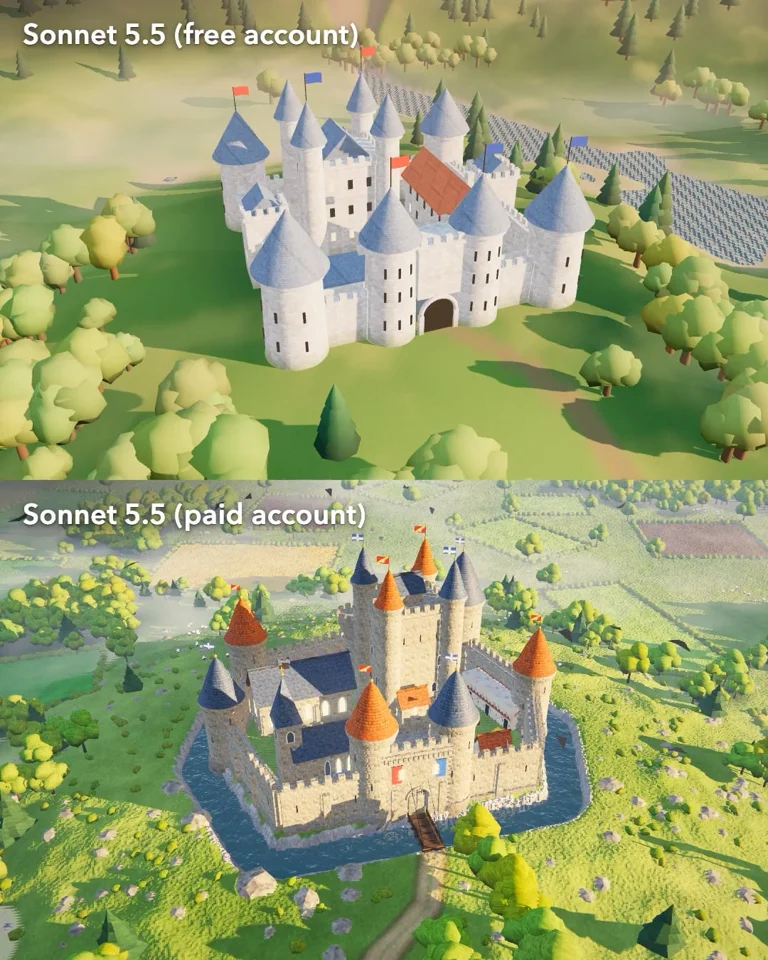
Can you generate an aerial view of a medieval stone castle and the surrounding grounds, early morning light, as a 3d model, in a single html file, allowing zooming and rotating, no words at all,…
Full prompt
>Can you generate an aerial view of a medieval stone castle and the surrounding grounds, early morning light, as a 3d model, in a single html file, allowing zooming and rotating, no words at all, just the scene.

Record the time you started, and finished.

These are the project requirements:

Professional visuals

>Produce finished professional work. Target the quality of an Awwwards-featured website, a commercial CGI campaign, or a published scientific illustration, whichever fits the request.

>Use the strongest appropriate rendering techniques. For realistic offline 3D, default to path tracing and global illumination. For interactive visuals, achieve comparable visual richness within the performance budget.

>Match the subject's real complexity. Include the irregularity, material variation, fine structure, and imperfections visible in its real-world equivalent.

>If the task is a 3D render, pay special attention to the geometry before anything else. Ensure that seams and attachment points look natural. No visual artifacts.

>Make specific artistic choices without waiting for direction. Choose the composition, lighting, camera, palette, and motion needed to make the requested subject compelling.

>Use the reference class that fits the work:

>Web: ready to submit to Awwwards.

>Natural environments: the richness and lighting of a high-end cinematic game environment.

>Objects and organisms: a professional asset shown in a commercial product render or natural-history close-up.

>Shaders and motion: a commissioned motion-design piece for a leading creative studio.

>Offline renders: a finished commercial CGI image, with production-quality geometry, materials, and lighting.

The one on my free account worked for \~5 mins, the paid one \~30 mins.

Thought it was noise, so I tried it 3 more times, and got similar results. Free one took 1-6 mins, paid one 20-35 mins. Similar visual quality as the above vid. After that, I hit limits on the free one, so I didn't go further.

This is on chat, not Claude Code btw. I asked the one on my paid account whether it had access to any of my preferences, skills etc, it said no. I wouldn't trust it fully, but it seems something might be going on.

Can anyone else confirm?
 r/ Prompt available0:36
over every 5 minutes. You plan your ship's actions for future ticks. *Between ticks the server is doing nothing* (except serving information to clients). When the next tick rolls around the server…
Full prompt
over every 5 minutes. You plan your ship's actions for future ticks.  *Between ticks the server is doing nothing* (except serving information to clients). When the next tick rolls around the server advances the bodies, and executes everything the players have planned for that tick. Everything happens ON THE SERVER. The client is just an interface to the server to assist you in planning your future actions. This is not a FPS! It's a slow-burn strategy game.  Take the long view.
* **persistent:** Whether or not you have the client open on your device, your ship is still flying through space on the server. You can't escape an attack by logging out (but you can by docking your ship at a station!).
* **single-shard:** Everyone is operating in the same solar system. There's only one instance of Burn Ledger.
* **2D:** The solar system is squished down to 2 dimensions. Everything happens in along the ecliptic. It's hard enough to intercept an enemy's ship in two dimensions; I can only imagine how hard it would be in three!
* **our solar system:** Yes! Our solar system, right now! All the bodies are exactly where they are in the night sky right now.
* **real orbital mechanics:** The physics in Burn Ledger uses a combination of Kepler orbits (for bodies) and deterministic Newtonian motion (for ships). Google Kepler vs Newton physics for some fun learning! The client shows you your ship's exact trajectory 5 days out factoring in the motion of the planets and any thruster burns you have planned. You will end up *exactly* where it says you will (unless someone vaporizes you). I took two liberties with ship physics to make the game more fun and playable:
   * **Fuel has no mass:** With some sci-fi hand-waving, fuel (measured in delta-V, or the amount it can change the velocity of your ship) in Burn Ledger has no mass (unlike today's space rockets), so you don't have to factor continuously-changing mass into your burn planning. Cargo, on the other hand, still has mass and will eat into your delta-V!
   * **Thrust is insane:** Thrust in Burn Ledger is shown as a multiple of